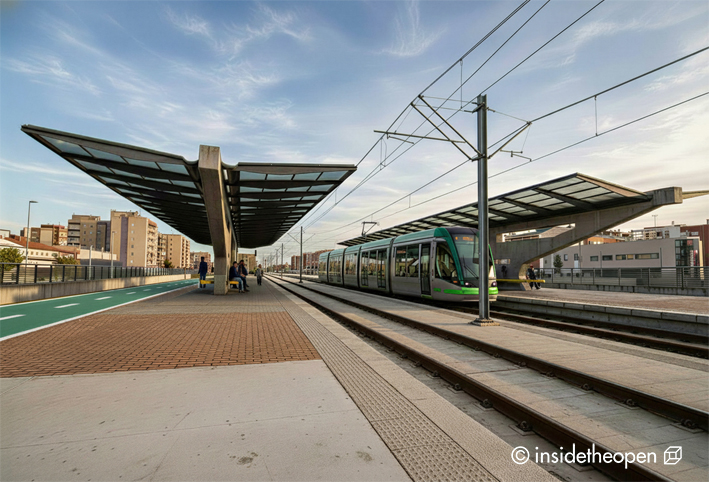
In the heart of the city, this shelter for buses, trams, and taxis emerges as a bold yet contemplative architectural gesture. Rejecting standardized solutions, the structure reinterprets the experience of urban waiting through a language that fuses minimalism, monumentality, and transparency. At its core stands a large spatial pillar—an abstract plate envisioned in reinforced concrete or steel—supporting a feather‑like canopy of glass panels framed in black metal. The interplay between the sculptural solidity of the support and the ethereal lightness of the roof generates a striking visual tension, capturing attention and inviting reflection. When paired in sequence, these elements function as a terminal, mediating between different modes of transportation. More than a protective device, the shelter asserts itself as an urban landmark: a symbolic gesture in dialogue with its surroundings, shaping both movement and memory within the city.
This canopy is not merely a technical installation, but a fragment of the city aspiring to become collective memory. Concrete, glass, and metal evoke an industrial aesthetic, while the composition offers a poetic reading of public space: waiting turns into experience, the everyday into symbol. In an era when infrastructures must be sustainable and recognizable, the shelter presents itself as a virtuous model, capable of welcoming and inspiring beyond function. The paving in large stone slabs and the open layout encourage permeability and integration with the urban context. A discreet yellow bench adds warmth and comfort without compromising formal purity.